Sunday, February 24, 2013

COMM 360: Living In The Studio World

Where did I start with all this Comm stuff anyway? I've been immersed in this world so long that it's hard to say exactly what got me into it.

Of course, I'm lying a bit here. I got into Comm when I made my first film, Chef's Torment, in March 2010. Of course, one could argue that the work I did with Christian Senn on the later canceled Project-S's promotional material was also a form of Comm. Never mind that though, as Chef's Torment is the relevant piece for this blog post.
 
 
When I first started making short films (which is how I ended up in the Shepherd Comm department), I was often very limited in the actors I could utilize. This meant being in films myself, which often meant using a tripod and very static shots in lieu of more interesting fare. Even when I did have actors, one thing or another (usually chroma-keying on a budget or faking double exposure in post) led to a boring job for cameraman Angus.

Which leads me to a point of contrast: the studio. As we've worked in the studio this semester, I had a chance to do some more interesting camera work. Camera stuffs in the studio is less creative, but MUCH more interesting.

So, I guess it stands out as great to me because I finally got to do one of the most fundamental parts of what I've been doing the past few years.

Tuesday, February 19, 2013

COMM352 - Hacking For Justice

Anonymous - So named for everyone's favorite 4chan user name, is perhaps one of the most polarizing groups in the world. They've targeted the corrupt (Westboro Baptist, Church of Scientology, 12chan [a child-porn centric spinoff of 4chan]), they've targeted the powerful (Sony, the FBI, Paypal). They are capable of changing the world at incredible speeds.

Anonymous is not just a hacking group. Anonymous is a political idea. The goal of Anonymous is personal freedom. They went after the FBI to stop SOPA/PIPA. They hit Paypal to assert the view that it is creating an online monopoly. The takedown of 12chan (as well as the tracking of several high profile child pornographers) was a very political move.  Anon was upset that the government was not taking adequate action against these criminals, so they used EXIF data to locate offenders and turn them in. They attacked sites like 12chan with DDOS methods and made access to their heinous resources impossible.

This is what freedom is really about. A world without corporate control over your life. A world where the bad are punished properly.

Long live anonymity.

COMM360 - Learning in The Studio

I LOVED working in the studio the past few weeks. I was particularly drawn to a couple of areas of the production.

I would say my favorite job was as talent. I'm know for being a very vocal person, and I do very well when I am being watched. After that, I liked audio work. I ended up doing the soundboard a few times, and I was quite taken with the process of that. I liked doing camera work, but it wasn't nearly as compelling as talent and audio.

I wasn't too excited about the floor jobs. Lighting and audio lost their magic when all I was doing was running wire and flipping switches, but to each his own.

Saturday, February 16, 2013

COMM 203: Podcasting About Women In Music


Show Notes: In this podcast, we discuss the role of women in music. First, we discuss Courtney Love and Gwen Stefani's 2004 feud that led to the creation of the song "Hollaback Girl". Next, we touch on the Grammy Awards and the strict dress code that was broken. Sarah brings in a job posting for female musicians, and we discuss Bikini Kill's Riot Girl Manifesto.

Starring - Angus Russell, Amanda Leguizamon, Sarah Myers, Jacob Teague.

And now for our sources -
http://www.onewarart.org/riot_grrrl_manifesto.htm


Tuesday, February 12, 2013

COMM 352: Wifi Everywhere

WiFi is such a ubiquitous term in our society, everything is advertised for it's WiFi capability these days. Of course, now that we have recievers of WiFi signals everywhere, people naturally want routers everywhere.

Hey, Hot-Spots are great. There's enough hot spots in even a small town that you could, with relative ease (and a small investment), you could use WiFi to eliminate your need of cell-phone service. If there was Wifi everywhere, then BOOM, free phone and internet for everyone.

But free WiFi everywhere won't work.

"ANGUS! Hot-Spots work and they're free!"

Let me tell you a little story. Last Summer, I spent a weekend in Indianapolis. Downtown, there's a WiFi network run by the state of Indiana that is accessible anywhere you go. It's called the State Public Wifi, and I used it like crazy.

It was slower than dial-up and told you upon connecting that it's DNS blocks any and all Dating, Piracy, or Pornography related websites. Pretty much what you'd expect in the blocking department, but nonetheless, it was a domain block, so if you knew the site's IP Address, you could still connect.

A few things people don't realize: The government would make a crappy ISP, The more people use a service, the slower it is, and radio waves are finicky bitches.

The government being the ISP solves the piracy issue. Right off the bat, they can block access to any material that allows people to commit crimes. They don't have to fight a middleman. Free Public WiFi would not contribute to piracy because they would block you from pirating.

The speed of the service is something easier to see: Our area has two choices: Comcast or Frontier. Both are massively faster at about 3 am. In the case of Indiana's WiFi, so many people were connected to it, it took the Google homepage a full minute to load. This is because the bandwidth sucks.

That leaves a radio-wave sized hole in the Free WiFi issue. Right now, start downloading a movie. Now put a microwave in the same room as your computer and heat up a Hot Pocket. Unless your router is only a few feet away, you'll notice the slowest download speeds ever.

This is due to the fact that the radiation from your microwave is stronger than the radiation from your router. Now imagine trying to get that free for everyone WiFi anywhere near a power plant, fast food place, or radio station. Hell, go sit in the parking lot of McDonalds and try to get their free WiFi during business hours. Untill you get into the building, you'll notice speeds that would make Dial-Up look AWESOME.

So, you know, maybe try to think of a way to overcome that radiation, make the bandwidth big enough to sustain the whole country, and preserve our right to steal from rich people, then we'll talk about free WiFi.

Tuesday, February 5, 2013

COMM 352: The Future Of The Computer

Today, I am a PC gamer. The nature of that is a consistently full hard drive. With 500 Gigabytes, I fill 450 with installed games. The future of the computer will change that, in an exciting way.

Two years ago, my hard drive was full of music, but Spotify came about and changed that. I no longer needed to keep Mp3s on my computer, I could stream everything I wanted for free.

Four years ago, I was using DVD Decrypter to save films I had on DVD to my hard drive, then converting them to play on my Iriver h10 Media Player with a 1.5 inch screen. Today, I can sit in the parking lot at Food Lion and find a movie on Netflix to watch on my 4 inch phone in seconds.

The industry is moving towards media that takes up no hard drive space. To this end, the service OnLive could someday solve my dilemma of gaming space. They offer streaming options for video games that use a server to store and render, then send you video feeds of the game while you send them input feeds. The service works better than you think, but it has a few huge drawbacks.

Streaming media can be taken away at any time, without notice. In fact, the only game I'd owned on OnLive was revoked. It's main competitor, Steam, does not work as a stream, but as a download. As such, they don't have to pay the streaming loyalties that OnLive pays. Steam has, since 2007, become the number one gaming download service in the world, while OnLive has been on the verge of bankruptcy several times.

The technology trends are moving to streams, but people would really rather have a permanent copy of things they pay for. Spotify and Netflix work because of a disinterest in re-experiencing films and popular music, but Amazon MP3 will always surpass Spotify in my mind because I feel that I own it more.

So, computer tech will work towards a world without local hard drives, and consumers will resist the hell out of it while also embracing it. That is the future.

Thursday, January 31, 2013

COMM 203: Relating With Technology

Last night, I experienced this whole "medium is the message" thing in a very real way.

This past Christmas, I received Nirvana's Nevermind on vinyl record. Last night, it occurred to me that I had not yet listened to all the bonus tracks. So, this being the only medium on which I had those PARTICULAR versions of the songs I've heard a million times (CHECK IT OUT GUYS, in this version, he says "Pay to play" instead of "Stay away"!) I was obliged to bring out the record player. 

Of course, listening to vinyl records when you could get the same experience in a more convienent format, such as, perhaps Mp3 or YouTube or... I was sitting at a gaming PC with a high speed internet connection and I opted to go physically out of my way to listen to the music in a format that was obsolete twelve years before I was born (Also, Nevermind is two years older than me, so there's that). If that's not the medium being the message, then I don't know what is.
You beautiful sonic reproduction utility with your pops and clicks.
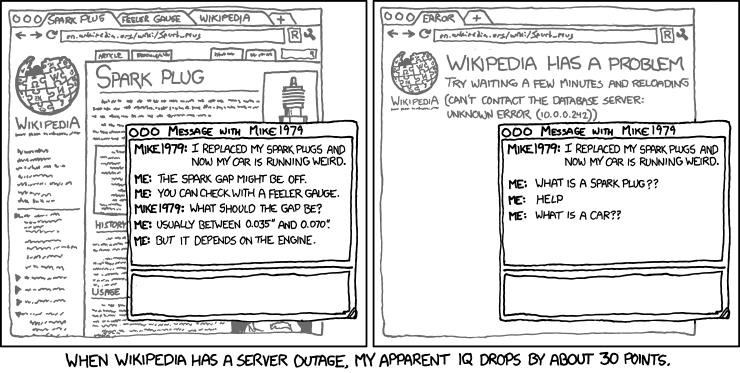
Of course, it's hard to imagine lugging around a record player as an extension of myself. For that, I have my MacBook. It goes with me everywhere and I use it for everything. Of course, the primary way one uses a computer as such an extension is the ability to, like, um, not... remember... hold on, gotta Google this... oh yeah, NOT REMEMBER ANYTHING OR LEARN EVER.

An excuse for me to use xkcd as part of school? Yes please. (Yay for Creative Commons!)
So, I'll admit to doing the whole internet as an extension of knowledge thing. On a certain level, it's good, but I'd hate to see how smart people are without being able to look everything up in five seconds.

I have to say, the biggest way I interact with that thing you youngins call the "information super highway network web blog pancake" is purchasing digital download games. Now, here's a little graphic I made to explain how insanely amazing and global village-y that process is.
I can communicate fast enough with the world that I have, on multiple occassions, bought products from a store based in London, had them tied to an account on a server in Seattle, and minutes later had the product downloading to my computer here in WV. 

The global village thing is also a lot of the reason that an awkward person like me has a number of friends. One of the people I'm closest to lives in Massachusetts and we can talk on Facebook almost as well as we could in person.

So, all that structuralist or determinist stuff- I think it's overwhelmingly a structuralist world, and, for the sake of arguement, I'll go back to the VCR and Betamax debate, sort of.

This article talks about Blu-ray and HDDVD, and how pornography was thought to be a big part of who was going to win, based on a similar situation that occurred in the VHS/Beta battles. Today, we know that a large part of why Blu-Ray won was, in fact, the other half of a 14 year old boy's interests, not pornography, but Playstation. 

Whether it's adult films or Duty being Called Of, this situation shows that, honestly, we all only will adopt a technology if it allows for, just, an insane advancement in entertainment. Excepting the IPad, which does nothing that a Windows XP Tablet from 2005 didn't do (consider Moore's Law where applicable to actual processing power) when it was laughed out of the market for being a useless luxury. If we have the free will to decide which technologies will win out, then the technology is not responsible for the way our society changes, we are.